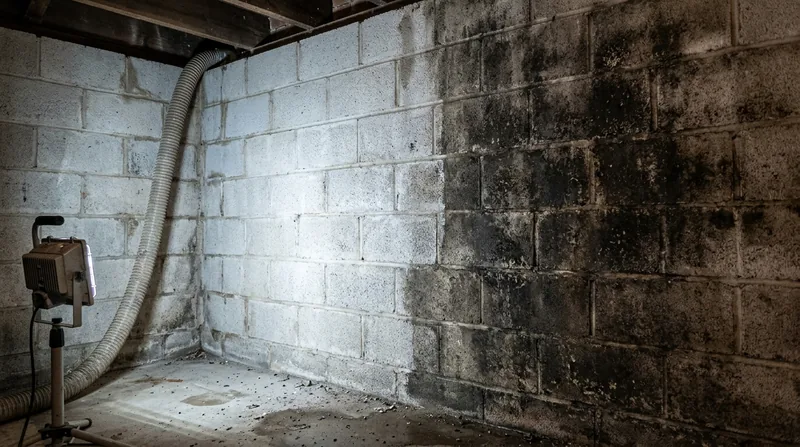




Basement Mold Remediation in Asheville: Fix the Moisture, Then Fix the Mold
Basement Mold Remediation in Asheville starts with a hard truth most homeowners learn the hard way: killing the mold without finding the water source is a waste of money. Our mountain climate keeps lower levels damp for months, and the red-brown clay that sits under most of this city holds stormwater against foundation walls like a sponge. We find the moisture path, remediate the affected surfaces, and correct the drainage so growth does not come back next humid summer. If your lower level smells musty after a wet week, start with a free basement inspection before you spend a dollar on cleanup.
Asheville is not the Midwest. Full basements are rare here, so most of our mold work happens in walkout basements on the Beaverdam and Lake Julian slopes, in the shallow lower levels of 1940s brick ranches in Oakley and West Asheville, and in the stone-walled lower rooms of 1920s Craftsman bungalows in Montford and Kenilworth. Each one leaks differently, and each one needs a different fix.
Why Basement Mold Grows So Fast in Asheville Homes
Mold needs three things: moisture, organic material, and still air. Asheville summers deliver all three. Relative humidity climbs into the 80s for weeks, the clay soil stays saturated after every storm, and a basement with no vapor barrier and no ventilation traps that damp air against wood framing, drywall paper, and cardboard stored on the floor. Add a failed sump pump or a clogged footing drain and you have a growth chamber.
- Hydrostatic pressure pushes water through hairline cracks and porous mortar in older stone and brick foundation walls.
- Efflorescence, that white chalky powder on the wall, tells you water is moving through the masonry right now.
- Failed sump pumps and frozen or disconnected discharge lines let water back into the sump basin during mountain storms.
- Missing or torn vapor barriers let ground moisture evaporate straight into the basement air.
- Grading that slopes back toward the house sends roof runoff and surface water against the foundation instead of away from it.
Every one of those is a moisture problem first and a mold problem second. We treat them in that order.
Key info: A 1950s brick ranch in Haw Creek had mold climbing the lower block wall every August. The cause was not a crack. It was a downspout dumping onto a grade that sloped back into the house, plus no vapor barrier. Sealing the wall alone would have failed. We corrected the grade, extended the downspout, installed a vapor barrier, and remediated the affected drywall and framing.
For official guidance on moisture and mold in buildings, the U.S. EPA maintains a plain-language resource at epa.gov/mold. It is a useful starting point before you call anyone.
How We Run Basement Mold Remediation in Asheville, Step by Step
We do not fog a basement and hand you a bill. Remediation means containment, physical removal of affected material, treatment of the surfaces that stay, and a documented moisture fix so the conditions that grew the mold are gone. The moisture diagnosis comes first because everything downstream depends on it.
- We walk the basement and the exterior grade, checking wall seepage, efflorescence, sump operation, downspout discharge, and the vapor barrier.
- We map the moisture source with a pin meter and a thermal camera so we know whether it is a crack, a wall, a floor joint, or humid air.
- We set up containment with poly sheeting and negative air pressure so spores do not spread to the rest of the house during removal.
- We remove porous materials that cannot be cleaned (drywall, insulation, cardboard, wood framing that is structurally compromised).
- We HEPA-vacuum and treat the remaining surfaces with an antimicrobial, then dry the space with dehumidifiers and air movers.
- We correct the moisture path: crack injection, interior perimeter drain, sump replacement, vapor barrier, or grading, depending on what the diagnosis showed.
- We clear the containment and verify dryness with a moisture meter before we call the job done.
If the diagnosis points to a wall that is taking water under pressure, the fix is often an interior drain tile system tied to a sump basin, not another coat of sealer.
Key info: A walkout basement in Swannanoa had mold on the framed wall along the uphill side. The downhill side was dry. The problem was not the wall itself. It was fast runoff from the slope above the house coming down against the foundation after heavy rain. We corrected the grade and drainage on that side and remediated the framing. Same house, two very different walls.
Remediation and Moisture Approaches We Use
Not every basement needs the same treatment. A single crack that weeps after rain is a crack repair. A wall that is damp across its whole face is a drainage and vapor problem. We match the approach to the diagnosis, and we tell you plainly when the cheaper fix is the right one.
| Approach | Description | Best for |
|---|---|---|
| Surface remediation | Containment, HEPA vacuuming, antimicrobial treatment of cleanable surfaces, removal of porous material. | Light growth on block or concrete walls with a known, correctable moisture source. |
| Crack injection | Epoxy or polyurethane injection through ports to seal the full depth of a foundation crack. | Isolated cracks that weep after rain, with no wall-wide dampness. |
| Interior perimeter drain | Drain tile along the inside of the footing, tied to a sump basin and pump. | Hydrostatic pressure under the floor and water at the wall-floor joint. |
| Vapor barrier and dehumidification | Heavy poly or dimple board on walls and floor, plus controlled dehumidification. | Humid, musty lower levels with no active water entry. |
| Sump pump replacement | New primary pump, check valve, and discharge line, with battery backup available. | Failed or undersized pumps that let the basin overflow during storms. |
The right approach is the one the moisture reading supports, not the most expensive one on the list.
Basement Mold Remediation Cost in Asheville: What to Expect
Most residential remediation jobs in Asheville start around $1,500 and climb from there. That starting figure covers a contained, limited-area job: one wall or one corner, a known moisture source, and a straightforward fix. The number moves up with the square footage affected, the depth of material that has to come out, and whether the moisture fix is a crack injection or a full interior drain tile system.
- Square footage affected is the biggest driver, because containment, removal, and drying all scale with it.
- Material type matters: drywall and insulation come out, block and concrete can often be cleaned and treated.
- The moisture fix is a separate line, and it is the line that keeps the mold from coming back.
- Access matters in older homes: a Montford bungalow with a narrow stone stairwell takes longer to work in than a Fletcher walkout with a wide door.
- Emergency work after a storm or a sump failure costs more than scheduled work.
Get two or three written estimates and make sure each one separates remediation from the moisture fix. A quote that only covers cleanup is a quote for a repeat job. Our full pricing overview lays out how we build a number.
Hiring a Basement Mold Remediation Contractor Near Me in Asheville
Mold remediation is not a licensed trade in North Carolina the way plumbing or electrical is, which means anyone with a truck can advertise it. That makes your vetting more important, not less. Ask for proof of general liability and workers comp, ask how they contain the work area, and ask what they do about the moisture source after the cleanup is done.
- Confirm the company is licensed and insured and ask for a certificate before work starts.
- Get at least two written estimates that itemize remediation and moisture correction separately.
- Ask for local references from jobs in Asheville, Black Mountain, or Weaverville you can actually call.
- Ask who pulls permits if the moisture fix involves structural foundation repair or a sump discharge tied to the sanitary line; rules vary by jurisdiction and the local building department has the final word.
- Ask whether the crew is employees or subcontractors, and who is on site during containment.
If a contractor cannot explain the moisture source in plain language, keep calling. You can reach us through our contact page and we will walk the basement with you.
Basement Mold Remediation in Asheville: Pricing Guide
| Service | Price | Details |
|---|---|---|
| Contained surface remediation | Starting at $1,500 | Covers containment, HEPA vacuuming, antimicrobial treatment, and removal of affected porous material in a limited area with a known moisture source. |
| Remediation plus crack injection | Starting at $2,200 | Adds epoxy or polyurethane injection of weeping foundation cracks, with cost rising by crack length and number of injection ports. |
| Remediation plus interior drain tile | Starting at $6,500 | For hydrostatic pressure under the floor; includes perimeter drain, sump basin, and pump, with linear footage driving the price. |
| Whole-basement remediation | On estimate | Needs an on-site moisture map before a number is given, since affected square footage and material depth vary widely. |
| Travel | Included | In Asheville and surrounding areas, no separate call-out or mileage fee. |
| Estimate | Free | Response within 24h at (828) 519-1276, no obligation to book. |
Indicative pricing, the exact cost depends on square footage, finish, and site access. Free personalized estimate within 24h at (828) 519-1276.


