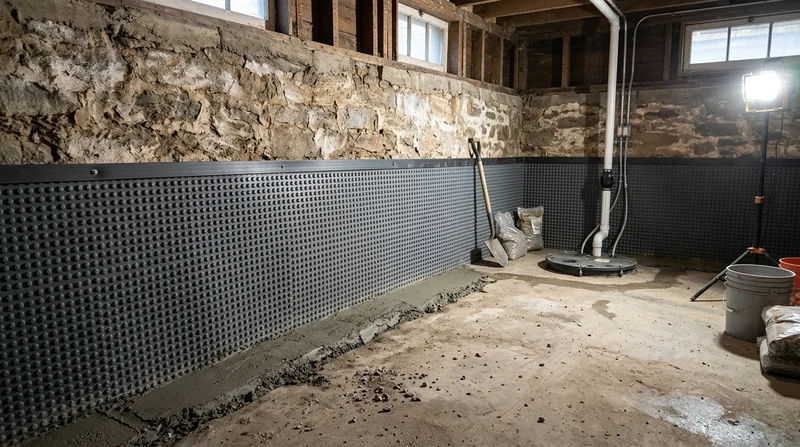




If you own a home with a lower level in Asheville, you already know that water does not need a crack to find its way in. The red-brown residual clay that sits on the slopes from Montford to Beaverdam holds rain for days, and when a mountain storm dumps two inches in an hour, that water pushes against stone, brick, and poured walls alike. Basement Waterproofing in Asheville is not a one-size product; it is a diagnosis. We trace where the water is actually coming from (the sloped side of the house, the floor joint, an old footing drain that has long since clogged) and build a system that moves it away for good. Whether you have a 1920s Craftsman bungalow in Kenilworth with a partial lower level or a 2005 walkout in Fletcher with poured concrete, the goal is the same: a dry basement after every storm. Call Asheville Waterproofing at (828) 519-1276 to start with a free inspection.
Why Basement Waterproofing Matters More Here Than Most Homeowners Realize
Asheville sits in a bowl of hills, and the building stock tells the story. Full basements are less common than in the Midwest, but walkouts, partial lower levels, and sloped-side foundations are everywhere. The dominant failure mode is not a single cracked wall; it is hydrostatic pressure from clay soil that swells in wet months and pushes water through mortar joints, cold joints, and the cove where the wall meets the floor. Add fast runoff from steep cuts and the occasional rise of the French Broad and Swannanoa, and you get a basement that stays damp from March through the summer.
- Stone and brick foundations in Montford and Chestnut Hill wick water through mortar and show efflorescence long before a puddle appears.
- Brick ranches in Oakley and West Asheville often have shallow lower levels set into the slope, where the uphill side takes the full weight of the water table.
- 1990s and newer subdivisions in Swannanoa, Weaverville, and Fletcher have poured walls and footing drains that can clog or fail within 20 years.
- Hillside homes on the Beaverdam and Lake Julian slopes rely on a functioning drain tile and sump system that many owners never inspect.
Ignoring a wet basement does not make it dry. It lets moisture sit against the building materials, which is exactly the condition that supports mold growth and rots rim joists and framing.
Key info: A homeowner in Haw Creek called us after every heavy rain because water pooled at the downhill corner of a 1960s brick ranch. The crack was minor; the real issue was a clogged footing drain and a downspout that dumped roof water two feet from the foundation. A simple free basement inspection found both in under an hour.
Before you spend money on any repair, understand the permit side. Structural foundation repair and work that alters drainage or the sanitary connection of a sump discharge commonly require a permit in North Carolina, and thresholds vary by jurisdiction. Always verify with the City of Asheville Permits and Inspections office or Buncombe County before work begins. You can review the city's official permit resources at Asheville Development Services.
How We Waterproof a Basement in Asheville: Diagnosis First, Then the Right System
We do not sell a single method to every house. The first step is always a walkthrough of the basement and the grade around it, because the water path tells you which system is correct. On a hillside walkout in Biltmore Forest, the answer is often exterior work on the uphill side plus an interior perimeter drain for the lower level. On a bungalow with a partial basement and a stone wall, interior drain tile leading to a sump basin is usually the cleaner, less disruptive choice. We tell you plainly when simple crack sealing is enough and when the real problem is pressure that no sealant will hold back.
- We inspect the basement walls, floor joint, window wells, and the grade on all four sides, and we check whether the existing footing drain is still flowing or has silted shut.
- We map the water path: uphill runoff, hydrostatic pressure, a failed downspout, or a high water table in the clay.
- We recommend the system that fits the house, from interior drain tile to exterior excavation and membrane, and we explain the tradeoffs in plain terms.
- We install the drain, sump basin, pump, check valve, and discharge line, and we treat the walls with a vapor barrier where moisture is coming through the masonry.
- We test the system with water before we leave and show you how to check the pump and backup.
That sequence matters because a sump pump without a proper drain to feed it is just a bucket in a hole, and a drain without a working pump is a channel that fills and stays full.
Key info: A Weaverville homeowner in a 2003 subdivision had water entering at the cold joint on the uphill wall every spring. The footing drain was intact but the sump pump had failed silently during a storm. We replaced the pump, added a battery backup, and the basement stayed dry through the next two wet seasons.
Waterproofing Methods We Use and When Each One Fits
There is no universal answer, and any contractor who says otherwise is selling a product, not a solution. Here is how the main approaches compare for Asheville homes.
| Approach | Description | Best for |
|---|---|---|
| Interior drain tile system | Perimeter channel cut at the floor joint, leading to a sump basin and pump. | Hydrostatic pressure and seepage at the cove, finished basements, stone and brick walls. |
| Exterior waterproofing | Excavation, membrane or dimple board, new footing drain, and graded backfill. | Failed exterior drain, bowing walls, hillside homes where the uphill side takes the pressure. |
| Crack injection | Epoxy or polyurethane injection through ports to seal a specific crack. | A single stable crack with no active pressure, often poured concrete walls. |
| Wall sealing and vapor barrier | Surface treatment and dimple board or sheet barrier to control moisture through masonry. | Damp walls, efflorescence, musty smell, and older stone foundations. |
| Sump pump and backup | Primary pump, check valve, discharge line, and battery backup for storms. | Any system that collects water, especially where power outages follow heavy rain. |
Most Asheville jobs combine two or three of these, and the right mix depends on the house, not on a sales target.
Basement Waterproofing Cost in Asheville: What to Expect
Homeowners ask for a number before they ask anything else, and that is fair. Pricing starts at From $2,500 for a focused repair such as crack injection or wall sealing on a small lower level. A full interior drain tile system with a sump pump and vapor barrier typically runs higher, and exterior excavation on a hillside home is the most involved scope. The spread is wide because the work is site-specific, and any quote given over the phone without seeing the basement is a guess.
- Access matters: a walkout in Fletcher is easier to work around than a tight partial basement in a 1920s Montford bungalow.
- Wall material matters: stone and brick foundations take more time to treat than poured concrete.
- Water volume matters: a high water table in clay soil calls for a larger sump basin and a stronger pump.
- Scope matters: a single crack is a small job, while a failed footing drain on the uphill side is a system replacement.
Get two or three written estimates and compare what is actually included, not just the bottom line. For a fuller breakdown of line items and typical ranges, see our basement waterproofing pricing page.
Choosing a Basement Waterproofing Contractor Near Me in Asheville
This is a category with a lot of door-knockers after every big storm, and the homeowner pays for the learning curve. A few checks separate a specialist from a sales operation. Confirm the company is licensed and insured, ask for the certificate, and call at least two recent references in your part of the county. Ask whether permits are required for your scope and who pulls them. If you live in a neighborhood with HOA rules, check whether exterior excavation or discharge routing needs approval before the crew arrives.
A contractor who tells you a crack is minor and only needs sealing, when that is the truth, is worth more than one who quotes a full system on the first visit. We are a dedicated basement waterproofing specialist, not a general foundation firm or a plumber, and we say so when the job is outside our scope. Reach out through our contact page to schedule an inspection and get a written estimate.
Basement Waterproofing in Asheville: Pricing Guide
| Service | Price | Details |
|---|---|---|
| Crack injection (epoxy or polyurethane) | Starting at $2,500 | Seals a single stable crack with injection ports; price rises with crack length and wall access. |
| Interior drain tile system with sump | Starting at $6,500 | Perimeter channel, sump basin, pump, and discharge; cost moves with basement size and wall material. |
| Exterior waterproofing with membrane | Starting at $9,000 | Excavation, membrane, new footing drain, and backfill; hillside access and depth drive the number. |
| Vapor barrier and wall sealing | Starting at $3,200 | Surface treatment and sheet barrier for damp masonry; stone walls take longer than poured concrete. |
| Complex or large-scale job | On estimate | Hillside walkouts and failed footing drains need an on-site look before any number is given. |
| Estimate | Free | Response within 24h at (828) 519-1276, no obligation to book. |
Indicative pricing, the exact cost depends on square footage, finish, and site access. Free personalized estimate within 24h at (828) 519-1276.


