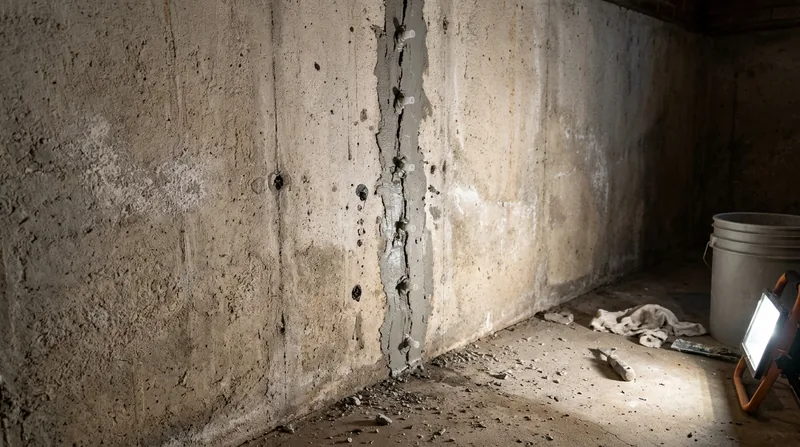




Foundation Crack Repair in Asheville
If you have a crack in your foundation wall, foundation crack repair in Asheville starts with understanding why the wall cracked in the first place. The mountains here are not the flat, deep-soil Midwest: our red-brown residual clay sits over granite and gneiss, swells in wet months, and pushes hard against older stone and brick foundations in Montford, Kenilworth, and Chestnut Hill. Hillside homes on the Beaverdam and Lake Julian slopes put real lateral load on the downhill wall, and fast storm runoff finds every hairline. We inspect the crack, trace the water source, and match the repair to the movement, not to a one-size patch. Start with a free basement inspection so we can see the wall before we quote.
Why Foundation Cracks Show Up in Asheville's Older and Hillside Homes
The building stock here explains most of the cracks we see. Craftsman bungalows and brick Tudors from the 1900s to 1930s often sit on stone or brick foundation walls with partial lower levels, and those mortars have been wet and dry for a century. Mid-century brick ranches in Oakley, West Asheville, and Haw Creek were set into the slope with shallow lower levels, so the uphill wall takes constant hydrostatic pressure. Newer poured concrete walls in Swannanoa, Weaverville, and Fletcher crack too, usually at shrinkage points or cold joints. The pattern is local: water in the clay, movement on the slope, and a crack that lets it through.
- Vertical cracks in poured walls usually come from shrinkage and are good candidates for epoxy injection.
- Diagonal cracks that follow the slope often signal settlement or lateral pressure from saturated clay.
- Horizontal cracks and bowing are structural warnings that need carbon fiber straps or wall anchors, not just sealing.
- White efflorescence and damp patches mean water is already moving through the wall, even if the crack looks small.
We tell homeowners plainly when simple crack sealing is enough and when the real problem is pressure that needs drainage, not more caulk.
Key info: In a 1920s Kenilworth bungalow, a hairline vertical crack in a stone wall was letting water into the lower level every big rain. The fix was polyurethane injection plus regrading the uphill side. A 1990s Weaverville poured wall with a wet diagonal crack needed injection and a footing drain check, because the crack was the symptom, not the cause.
For official guidance on when structural foundation work needs a permit, check the City of Asheville Development Services Department at ashevillenc.gov, since thresholds vary and must be verified for your address.
How We Diagnose and Repair Foundation Cracks in Asheville
Every crack gets the same first question: is it moving, and is water pushing from behind it? We walk the interior and exterior, check the grade and downspouts, look for efflorescence, and probe the wall where the crack runs. Then we choose the method. Non-structural cracks get epoxy or polyurethane injection through ports drilled along the crack. Cracks with active seepage get polyurethane, because it foams and cures in wet conditions. Wider or shifting cracks on a slope get structural repair with carbon fiber straps or wall anchors, and if hydrostatic pressure is the driver, we recommend an interior drain tile system so the wall stops taking the load.
- We inspect the crack, the wall, and the grade around the foundation to identify the cause.
- We clean the crack and drill injection ports at the proper spacing for the wall material.
- We inject epoxy for dry, stable cracks or polyurethane for wet, active ones.
- We seal, finish, and check the repair before we leave the site.
- We recommend drainage or structural work only when the inspection shows it is needed.
That order matters in Asheville because injection alone will not hold a wall that is being pushed by saturated clay on a steep cut.
Key info: A walkout basement in Swannanoa had a wet crack on the downhill wall and a dry crack on the uphill wall. The dry crack got epoxy injection. The wet one got polyurethane injection plus a downspout extension and regrading, because the runoff was coming off the slope faster than the soil could take it.
Foundation Crack Repair Methods We Use in Asheville
| Approach | Description | Best for |
|---|---|---|
| Epoxy injection | Ports drilled along the crack, epoxy injected to bond the concrete back together. | Dry, stable vertical cracks in poured walls. |
| Polyurethane injection | Foaming resin that cures in wet conditions and fills the crack from inside. | Active leaks and cracks with water behind them. |
| Carbon fiber straps | Straps anchored to the wall to resist lateral movement. | Bowing walls and cracks that are still moving. |
| Wall anchors | Anchors driven into stable soil and tied to the wall to pull it back. | Bowing walls on hillside lots with pressure from clay. |
| Drainage correction | Grading, downspout extensions, and drain tile work to relieve hydrostatic pressure. | Cracks that keep returning after injection. |
The right method depends on the wall, the water, and the slope, and we explain the choice before we start.
Foundation Crack Repair Cost in Asheville: What to Expect
Most single-crack injection jobs in Asheville start at From $450, and that figure covers a straightforward crack with good access. Cost moves with the number of cracks, the wall material (stone and brick take more time than poured concrete), whether the crack is wet, and whether we need to add drainage or structural work. A bowing wall with anchors is a different scope and gets an on-site estimate. We give you a written number before any work starts, and we tell you when sealing is all you need. See the full pricing overview for context on how jobs are priced.
Getting two or three estimates is smart in this market. It lets you compare scope, not just the number, and it protects you from a patch that ignores the water source.
What to Look for When Hiring Foundation Crack Repair Near Me in Asheville
Hiring near Asheville means checking three things before anyone touches the wall: license and insurance, a written scope, and references from local jobs. Ask whether the contractor carries general liability and workers' compensation, and ask for a certificate. Ask if permits are required for your scope (structural repair and drainage changes often trigger them, and the city building department has the final word). Get the scope in writing, including which cracks are being injected and which are being monitored. And call a reference or two from your side of town, because a hillside lot in Woodfin and a flat lot in Fletcher are not the same job.
Reach out through our contact page to set up an inspection.
Foundation Crack Repair in Asheville: Pricing Guide
| Service | Price | Details |
|---|---|---|
| Single crack injection (epoxy or polyurethane) | Starting at $450 | Includes inspection, port drilling, injection, and finish for one accessible crack. |
| Multiple crack injection | Starting at $750 | Priced per crack after the first; wall material and access affect the total. |
| Structural repair (carbon fiber or anchors) | On estimate | Bowing or shifting walls need an on-site look before a number is given. |
| Drainage correction add-on | On estimate | Grading, downspout extensions, or drain tile quoted with the crack repair scope. |
| Travel | Included | in Asheville and surrounding areas, no separate call-out or mileage fee |
| Estimate | Free | Response within 24h at (828) 519-1276, no obligation to book |
Indicative pricing, the exact cost depends on square footage, finish, and site access. Free personalized estimate within 24h at (828) 519-1276.


