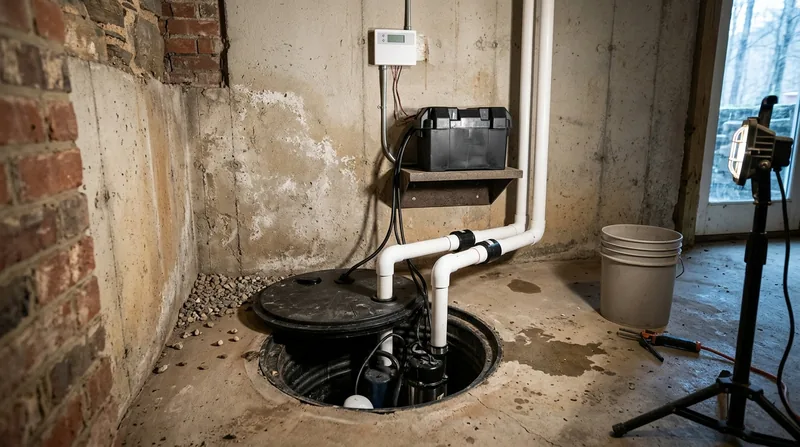




Battery backup sump pumps in Asheville are not an upgrade you add for peace of mind. They are the piece of equipment that decides whether a finished lower level floods at 2 a.m. during a mountain storm. Asheville's housing stock makes that risk concrete: 1900s Craftsman bungalows in Montford and Kenilworth sit on stone and brick foundations with partial lower levels, while 1990s to 2020s subdivisions in Swannanoa, Weaverville and Fletcher use poured concrete walls and a primary pump that runs hard when red-brown residual clay stops taking water. Heavy storms push fast runoff down the slopes toward low corners, and the French Broad and Swannanoa rivers back up low ground after big rains. Duke Energy outages during those same storms are exactly when the pit fills fastest. We size, install and service backup systems built for that scenario. Start with a sump pump installation and replacement review if your primary pump is already suspect.
Why Asheville Storms Make a Backup Pump Non-Negotiable
The dominant failure mode here is a power outage during a heavy rain event. The same cell that dumps two inches in an hour on the Beaverdam slopes is the one that takes the feeder line down, and a primary sump pump with no power is a decoration. Older homes in West Asheville and Haw Creek with shallow lower levels set into the slope fill faster than owners expect because the uphill grade concentrates flow at one wall. Newer Fletcher and Weaverville builds are tighter but not immune: a failed check valve or a burned-out float switch floods a pit just as fast as an outage.
- We confirm the primary pump's actual output before sizing any backup, because a backup cannot outrun a primary that is already undersized.
- We test how long your pit holds water during a real storm cycle, since a small basin fills in minutes and drains the battery fast.
- We check the discharge line and check valve for freeze or clog risk on north-facing walkout walls.
- We map the low corner of the foundation, the spot where runoff from the slope actually lands.
If your pit has never been load-tested, that is the first thing we do, not the last.
Key info: A 2019 storm cycle left a Montford bungalow without power for nine hours while its stone foundation footing drain fed a pit at roughly 40 gallons a minute. The primary pump was fine. The backup was not installed. That is the call we get most often after a big rain.
For official guidance on storm preparedness and power restoration in the region, see the City of Asheville resources, and always confirm local electrical and plumbing permit requirements with the Asheville building department before any discharge or circuit work.
How We Install a Backup System on an Asheville Foundation
We do not sell a box and walk away. The job starts with the pit and the discharge, because a backup pump bolted into a bad basin or tied into a clogged line fails on schedule. On hillside walkouts off the Lake Julian slopes, the discharge often has to be re-routed to a grade that actually sheds water instead of dumping it back against the wall. On older brick and stone foundations, we protect the existing pit penetration and avoid cutting new holes where the wall is already stressed.
- We inspect the sump basin, the primary pump, the float switch and the check valve, and we measure actual inflow during a wet period.
- We size the backup battery and pump to your pit volume and your typical outage length, not to a generic chart.
- We install the backup pump on its own dedicated discharge path with a separate check valve so the two pumps never fight each other.
- We wire the charger and alarm to a circuit that stays live, and we label every connection for the next person who opens the lid.
- We run a live test with the primary breaker off, then walk you through the alarm and the reset.
Every install ends with a documented test, not a verbal promise.
Key info: A Swannanoa homeowner with a 1990s poured-wall basement had a backup pump wired to the same circuit as the primary. When the breaker tripped, both pumps went dead. We split the circuits, added a battery alarm and re-piped the discharge to a daylight outlet. The fix took half a day. The flood it prevented would have taken weeks to dry.
If your pit also needs a new basin or a full interior perimeter drain, that work is handled on our interior drain tile system page.
Backup Pump Options We Install
Not every basement needs the same hardware. A shallow lower level in a 1940s Oakley ranch and a deep walkout on a Beaverdam slope have different inflow profiles and different outage exposure. The table below shows the approaches we actually install and where each one fits.
| Approach | Description | Best for |
|---|---|---|
| Battery backup pump | A 12V DC pump with a dedicated battery and charger, installed alongside the primary AC pump. | Homes with a working primary pump and a real outage history. |
| Combination primary and backup unit | One housing with an AC primary and a DC backup, sharing a single discharge. | Tight pits where two separate pumps will not fit. |
| High-capacity battery bank | Larger deep-cycle capacity for multi-day outages common after mountain storms. | Deep walkouts and pits with high inflow during storms. |
| Alarm and monitoring add-on | Audible and remote alarm on high water, battery fault and pump failure. | Owners who travel or rent out the property. |
| Maintenance and load test | Annual battery load test, float check and discharge line clearing. | Any installed system, especially before storm season. |
Pick the approach that matches your actual inflow, not the biggest box on the shelf.
Battery Backup Sump Pumps Cost in Asheville: What to Expect
Most Asheville homeowners ask the price before they ask about the pump, and that is fair. A basic battery backup installation starts from $900, and that figure covers a standard pit, a dedicated backup pump, a battery and charger, a separate check valve and a live test with the primary breaker off. The number moves for reasons you can see before we arrive: pit depth and condition, whether the discharge has to be re-routed, the battery capacity you need for multi-day outages, and whether the electrical circuit has to be split or added.
Two more factors drive cost in this market. First, older stone and brick foundations in Montford and Chestnut Hill sometimes need the pit penetration rebuilt before any pump goes in. Second, hillside walkouts on the Beaverdam and Lake Julian slopes often need a longer discharge run to a grade that sheds water. We price those after an on-site look, not over the phone.
Get two or three written estimates and compare what is actually included: battery size, discharge routing, alarm, and whether a live test is part of the job. A cheap quote that skips the test is not a cheaper job. Our full pricing overview shows how the line items break down.
Battery Backup Sump Pumps Near Me: Hiring a Contractor Near Asheville
You want a contractor who will tell you when a backup pump is the wrong answer. If your primary pump is undersized or your pit is dry most of the year, the honest recommendation may be a primary replacement first. Use the same checklist you would for any below-grade work.
- Confirm the company is licensed and insured, and ask for the certificate before work starts.
- Get at least two written estimates and compare scope, not just the bottom line.
- Ask for local references from jobs in Asheville, Black Mountain or Weaverville, and call them.
- Ask who pulls any required electrical or plumbing permit for the discharge or circuit, and confirm the rule with the local building department because thresholds vary by jurisdiction.
- Ask whether the installer will run a live test with the primary off before calling the job done.
A contractor who cannot answer those five questions before scheduling is not the one you want in your pit.
To book an inspection or a free estimate, reach us through the contact page or call (828) 519-1276. We serve Asheville and the surrounding mountain communities, and we will tell you plainly if a backup pump is not what your basement needs.
Battery Backup Sump Pumps in Asheville: Pricing Guide
| Service | Price | Details |
|---|---|---|
| Standard battery backup installation | Starting at $900 | Includes backup pump, battery, charger, separate check valve and live test with the primary off. |
| Combination primary and backup unit | Starting at $1,250 | Single housing with AC primary and DC backup, best for tight pits with limited space. |
| High-capacity battery bank | Starting at $1,600 | Larger deep-cycle capacity sized for multi-day outages common after mountain storms. |
| Alarm and monitoring add-on | Starting at $250 | Audible and remote alarm on high water, battery fault and pump failure. |
| Discharge re-route or circuit split | On estimate | Needs an on-site look at grade, discharge path and panel before a number is given. |
| Annual maintenance and load test | Starting at $185 | Battery load test, float check and discharge line clearing, best done before storm season. |
Indicative pricing, the exact cost depends on square footage, finish, and site access. Free personalized estimate within 24h at (828) 519-1276.


