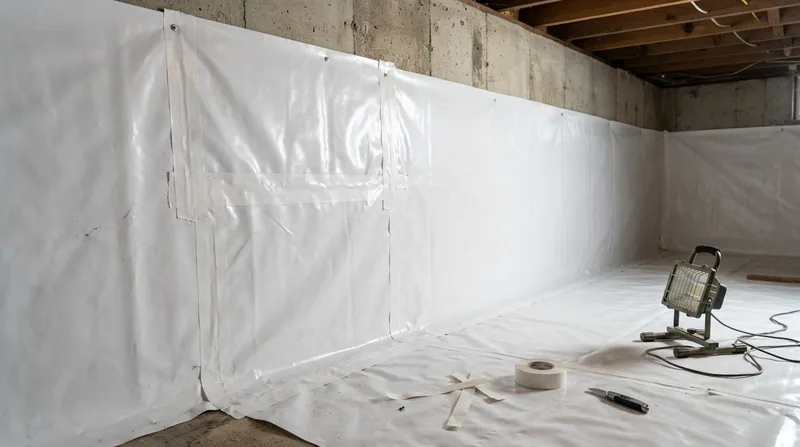




Vapor Barrier Installation in Asheville: Seal Out Ground Moisture for Good
When Asheville's red-brown clay soil stays saturated through the wet months, moisture migrates through concrete and masonry foundation walls and pushes damp air into your lower level. That is where Vapor Barrier Installation in Asheville earns its place: heavy-duty barrier sheets sealed across the walls and floor to cut off that ground moisture at the source. In older Montford and Kenilworth homes with stone or brick foundation walls, and in 1990s-and-newer poured concrete walkouts in Fletcher and Weaverville, the barrier is the difference between a dry room and a damp one. We install it with sealed seams, taped terminations, and sump integration where the floor drains need it. If you want to see how it fits alongside a full drainage plan, start with our basement waterproofing service.
Why Vapor Barrier Installation Matters in Asheville's Damp Clay and Hillside Foundations
The dominant failure mode here is not a single crack letting in a trickle. It is persistent ground moisture from residual clay that holds water for weeks after a mountain storm, then releases it slowly through the foundation wall and slab. That is why efflorescence, a musty smell, and damp concrete show up long before standing water does. A properly installed vapor barrier blocks that vapor path and keeps the lower level materially drier.
- Clay soil around the footing keeps the wall damp long after the rain stops, and a barrier stops that moisture from entering the room.
- Hillside walkouts on the Beaverdam and Lake Julian slopes face hydrostatic pressure on the uphill side, where vapor drive is strongest.
- Older stone and brick walls in Montford and Chestnut Hill wick moisture readily, so the barrier needs a dimple board standoff to let the wall dry inward.
- Poured concrete walls in Swannanoa and Fletcher subdivisions pass vapor through the slab, which a floor membrane addresses directly.
Sealing the vapor path is the low-cost step that makes every other repair hold, and we tell homeowners plainly when a barrier alone is enough and when water is arriving under pressure that needs drainage first.
Key info: A 1970s brick ranch in Oakley with a shallow lower level set into the slope had efflorescence on the back wall every spring. The wall itself was sound. The moisture was vapor coming through the concrete slab and the uphill wall, and a sealed barrier with a dimple board air gap dried the room without any excavation.
For the code side of any work that alters drainage or a sump discharge, check the City of Asheville's permit guidance at ashevillenc.gov Development Services and confirm the current requirements with the building department before work begins.
How We Install a Basement Vapor Barrier in Asheville Homes
We start by finding where the moisture is actually coming from, because a barrier over a wet wall traps water instead of stopping it. On a hillside walkout in Woodfin or a Craftsman bungalow in West Asheville, that means checking the uphill wall, the footing line, and the slab separately. Then we build the barrier system in a sequence that keeps the wall able to dry and the floor able to drain.
- We inspect the walls, floor, and footing line and test for active seepage versus vapor drive.
- We correct any active leak first, using crack injection or drainage where the water is under hydrostatic pressure.
- We fasten dimple board against the wall to create a drainage and drying gap behind the barrier.
- We roll out heavy-duty barrier sheet across the floor and up the walls, overlapping every run.
- We seal all seams and tape the terminations at the perimeter and around penetrations.
- We integrate the barrier with the sump basin and discharge so floor water still reaches the pump.
- We verify the finished surface is tight, flat, and ready for flooring or storage.
The result is a continuous sealed envelope that keeps ground vapor out of the room instead of letting it pass through the slab and walls.
Key info: In a 2010s Weaverville subdivision home, the slab read damp all summer and the homeowner assumed a leak. The sump was working fine. The fix was a floor barrier tied into the existing basin, with the seams taped and the perimeter sealed, which stopped the vapor without touching the drainage.
Where the floor needs drainage before a barrier goes down, we pair the work with an interior drain tile system so water is collected and removed rather than trapped under the membrane.
Vapor Barrier Options We Use in Asheville Basements
The right barrier depends on the wall type, the amount of vapor drive, and whether the floor drains. We match the material to the house rather than selling one product for every job, and we explain the tradeoffs before we start.
| Approach | Description | Best for |
|---|---|---|
| Wall dimple board plus barrier | Rigid dimple mat against the wall creates a drying gap, with sealed barrier sheet over it. | Stone and brick walls in Montford and Chestnut Hill that wick moisture. |
| Floor membrane with sealed seams | Heavy-duty sheet rolled across the slab, overlapped and taped at every run and at the perimeter. | Damp slabs in poured concrete homes in Swannanoa and Fletcher. |
| Full wall and floor envelope | Continuous barrier from wall to floor, integrated with the sump and discharge. | Hillside walkouts on the Beaverdam slopes with vapor on two faces. |
| Targeted barrier after crack repair | Inject the crack, then seal the surrounding wall and floor with barrier sheet. | Older homes where one wall shows seepage and the rest is dry. |
Every option ends with taped terminations and a verified seal, because an unsealed edge lets vapor straight back in.
Vapor Barrier Installation Cost in Asheville: What to Expect
Most Asheville vapor barrier work starts around $3 per square foot of treated area, and that figure moves with wall condition, access, and how much prep the floor needs. A clean poured concrete slab in a newer Fletcher home sits at the low end. An older brick wall that needs dimple board, crack injection first, or sump integration sits higher. We price the scope you actually have, not a package.
Access matters more than people expect. A walkout with a direct grade entrance is fast to work in. A low, tight lower level in a 1920s bungalow means carrying materials through the house and working in short sections, which adds labor. Wall condition is the other driver: a sound wall takes a barrier directly, while a wall with active seepage needs repair before the barrier goes on.
Get two or three written estimates and compare scope line by line, not just the total. Ask each contractor whether the price includes seam sealing, sump integration, and any crack repair first. Our full pricing overview lays out how we build a number.
Vapor Barrier Installation Near Me: How to Choose a Waterproofing Contractor Near Asheville
A barrier is only as good as the diagnosis behind it, so hire someone who inspects before quoting. Ask whether they are licensed and insured, request the certificate, and confirm the crew doing the work is their own. Check references from homes like yours, especially older brick or stone foundations where the detailing is different.
Ask how they handle permits. Work that alters drainage or the sanitary connection of a sump discharge commonly needs a permit in this region, and the rules vary by jurisdiction, so the contractor should tell you who pulls it and defer to the local building department. If you are in an HOA, confirm any exterior discharge routing requirements before work starts.
Finally, get the scope in writing: material type, seam sealing, sump integration, and cleanup. A clear written scope protects you more than any verbal promise. Reach out through our contact page to schedule an inspection and a free estimate.
Key info: A homeowner in Black Mountain compared three quotes. The lowest one skipped dimple board on a brick wall, which would have trapped moisture against the masonry. The written scope, not the price, is what told the real story.
When a Barrier Alone Is Not Enough
We are honest about this because it saves homeowners money. If water is arriving under hydrostatic pressure, a barrier over the wall will fail. The real fix is drainage: an interior perimeter drain or an exterior footing drain, depending on the house. A barrier then finishes the job by blocking the vapor that remains.
If you see water pooling at the cove joint after heavy rain, or the sump runs constantly, call us at (828) 519-1276 for an inspection before choosing a barrier. We will tell you which problem you actually have and what it takes to fix it.
Vapor Barrier Installation in Asheville: Pricing Guide
| Service | Price | Details |
|---|---|---|
| Floor vapor barrier | Starting at $3/sq ft | Heavy-duty sheet, overlapped runs, all seams taped and perimeter sealed. |
| Wall barrier with dimple board | Starting at $4/sq ft | Dimple mat drying gap plus sealed barrier sheet, priced by wall height and access. |
| Full wall and floor envelope | Starting at $5/sq ft | Continuous barrier integrated with the sump basin and discharge line. |
| Barrier after crack repair | On estimate | Injection must be completed and cured first, so scope is set on site. |
| Travel | Included | In Asheville and surrounding areas, no separate call-out or mileage fee. |
| Estimate | Free | Response within 24h at (828) 519-1276, no obligation to book. |
Indicative pricing, the exact cost depends on square footage, finish, and site access. Free personalized estimate within 24h at (828) 519-1276.


