What Is Residual Clay and Why Does It Matter on Mountain Lots?
If you live on a mountain lot around Asheville, the ground beneath your home is likely not the sandy, well-drained soil you might expect. Much of this region sits on residual clay, a dense, sticky soil formed from the weathering of bedrock over thousands of years. Unlike transported soils that were carried in by water or wind, residual clay stays right where it formed, which means it retains the same mineral composition and shrink-swell behavior as the rock below it.
That matters because residual clay expands significantly when it absorbs water and contracts just as dramatically when it dries out. On a flat lot, this movement is usually manageable. On a mountain lot, where slopes concentrate water and soil depths vary from a few inches to several feet, the movement becomes uneven and unpredictable. Your foundation may be sitting on clay that swells on one side and stays stable on the other, and that differential movement is exactly what cracks foundations and opens pathways for water to enter lower levels.
How Residual Clay Causes Asheville Foundation Cracks
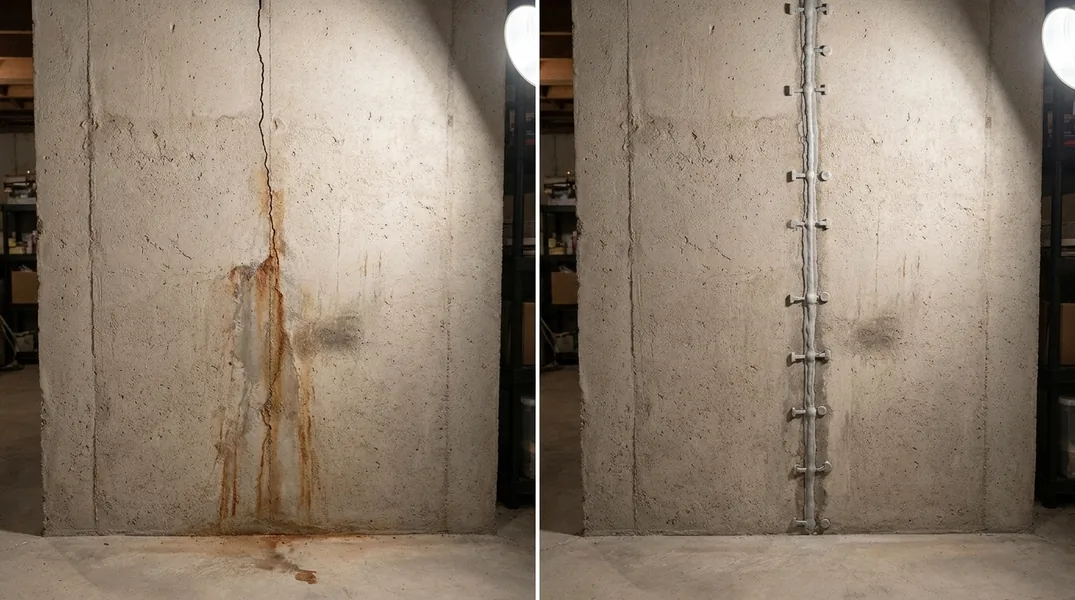
When residual clay absorbs moisture, it can exert upward and lateral pressure measured in thousands of pounds per square foot. Foundations are engineered to resist typical soil loads, but they are not designed to withstand the constant cycling of expansion and contraction that mountain clay produces. Over a few seasons, this pressure creates hairline cracks in poured concrete walls, separates block mortar joints, and can even bow walls inward. Homeowners in Black Mountain and other hillside communities often notice these cracks first in basements and crawl spaces, where the foundation wall meets the floor.
What makes Foundation Waterproofing so important in this environment is that cracks rarely stay cosmetic. Once a crack forms, it becomes a direct channel for groundwater. During heavy mountain rains, water pools against the foundation, finds those cracks, and seeps into your lower level. The clay that caused the crack in the first place then holds that water against your foundation, keeping the soil saturated and the pressure high. It is a cycle that worsens with every wet season unless it is interrupted.
Why Clay Soil Basement Leaks Are So Common in the Mountains
Clay soil basement leaks are especially common on mountain lots because water has nowhere to go but down. Residual clay has very low permeability, meaning it does not drain well. When rain falls on a slope, it runs across the surface until it hits a depression or your foundation, then it sits there. The clay absorbs what it can, swells, and pushes against your basement wall while the remaining water seeps through any available opening. Homes in Weaverville and similar areas with heavy spring rainfall often see damp basements, efflorescence on walls, and musty odors that signal ongoing moisture intrusion.
Mountain soil movement adds another layer of complexity. Slopes are rarely uniform, so water collects in pockets, and the clay in those pockets behaves differently than the clay ten feet away. This uneven saturation causes foundation walls to be pushed from different directions at different times. A wall that was plumb last year may be slightly out of alignment this year, and the cracks that result let in more water. Without a drainage strategy that accounts for both surface water and subsurface clay behavior, leaks tend to return no matter how many times you patch the cracks.
Basement Waterproofing Near Me: Solutions That Work With Mountain Clay
The right solution for a clay-heavy mountain lot depends on where the water is coming from and how the foundation is moving. For many homes, Basement Waterproofing starts with managing water before it reaches the wall. That can mean regrading the soil around the foundation, extending downspouts well away from the house, and installing surface drainage that directs runoff around the structure rather than through it. On steeper lots, French drains or swales may be needed to intercept water uphill and carry it safely past the home.
When water is already entering the basement, an Interior Drain Tile System can capture it at the point of entry and route it to a sump pump, relieving hydrostatic pressure against the wall. For homes with significant exterior clay pressure or recurring wall cracks, Exterior Basement Waterproofing may be the more durable fix because it addresses the soil side of the problem. A professional assessment is the only way to know which approach fits your lot, and you can request a free estimate to get started.
Foundation Crack Causes: When to Call a Professional
Not every crack is an emergency, but some are. Horizontal cracks, stair-step cracks in block walls, and cracks wider than a quarter inch are warning signs that soil pressure or settlement has compromised the foundation. If you also notice doors sticking, floors sloping, or water staining on basement walls, the movement is likely active. In a region where mountain soil movement is a constant factor, waiting to see if a crack gets worse usually means paying for a larger repair later.
A professional inspection can distinguish between cosmetic shrinkage cracks and structural ones, and it can identify whether the water problem is coming from the soil, the roof, or the foundation itself. Asheville Waterproofing evaluates the whole system, from grading and gutters to foundation walls and drainage, so the fix addresses the cause rather than just the symptom. If you are unsure about a crack or a damp spot in your basement, call (828) 519-1276 to talk through what you are seeing and schedule an assessment.
Basement Waterproofing Cost in Asheville: What to Budget
Homeowners often ask what waterproofing will cost before they understand the cause of their leak, and the honest answer is that it varies. A simple crack injection or regrading project costs far less than a full exterior excavation, and an interior drain tile system falls somewhere in between. The variables that matter most are the length of the foundation wall involved, the severity of the clay pressure, whether a sump pump is needed, and how accessible the exterior is on a sloped lot. Homes in Fletcher with flatter lots may need less extensive work than a steep hillside property in the mountains.
Rather than guessing, it is worth getting a written scope of work that explains what will be done and why. A reputable contractor will walk you through the options at different budget levels and explain the trade-offs between short-term fixes and long-term solutions. You can review general pricing guidance online, but a site visit is the only way to get an accurate number for your home. Budget for the cause, not just the visible leak, and you will avoid paying twice for the same problem.
Looking for a professional basement waterproofing contractor in Asheville? Asheville Waterproofing responds fast for all your basement waterproofing needs.
Get a Free QuoteOur services: Basement Waterproofing · Interior Drain Tile System · Exterior Basement Waterproofing